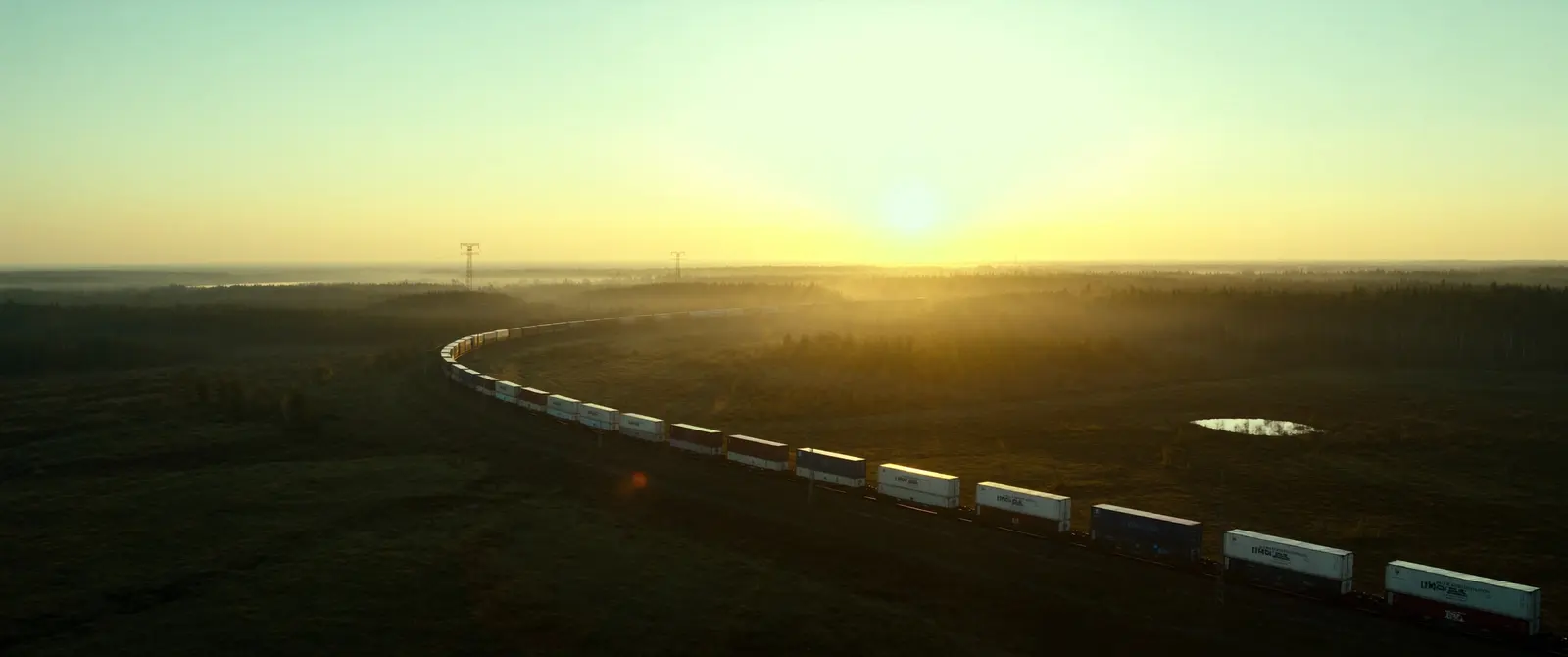
What the trade relationship looks like from an investor's seat
The flow is asymmetric. Russia ships bulk commodities and intermediate goods; China ships finished manufactures, machinery and components. That asymmetry is the investment map: margins for a foreign participant tend to be in assembling, sorting, packaging, certifying and financing the flow, not in producing the raw material.
The macro backdrop matters because it determines demand for the infrastructure this trade needs. Russian real GDP grew 4.1% in 2023 and 4.9% in 2024 (Rosstat, 2023-2024), and general government debt stood at 17% of GDP against 124% in the United States (IMF WEO, 2025). A low debt load does not by itself create opportunity, but it does mean infrastructure spending is less constrained than in most peer markets.
- Russian export side: energy carriers, metals, fertilisers, grain, timber, seafood. Russia is the world's number one palladium producer with 44% of global supply (USGS, 2025).
- Chinese export side: vehicles and components, electronics, industrial and consumer equipment.
- Practical consequence: demand is steady for warehouses, rail sidings, container yards, certification labs and trade finance in both directions.
- The negotiable part is usually the intermediary function, not the commodity price.
How the money actually moves
Settlement is the first thing to solve, before any contract is signed. 86% of Russian exports are settled in rubles and currencies of friendly countries (Bank of Russia, 2025), which means the renminbi is now a working trade currency rather than an exotic one. Contracts can be denominated in renminbi, rubles or a third currency, but the practical question is which banks on both sides will process the payment and how long screening takes.
Payment channels are the single most fragile part of a Russia-China trade structure. Banks apply their own compliance policies, and those policies change without notice to you. A structure that clears one quarter may slow down the next, so treat the payment route as something to be re-verified rather than assumed.
Documentation discipline is not bureaucracy here, it is the thing that determines whether the money arrives. Goods descriptions, HS codes, invoices and customs declarations that do not match exactly are the most common cause of a frozen transfer.
- Do not depend on a single bank or a single currency corridor; have a documented fallback.
- Budget for longer compliance and KYC/KYB cycles than in a Western corridor, and price that delay into working capital.
- Align every commercial document with the customs declaration before shipment, not after.
- Take independent compliance advice on your own structure and counterparties; this is a legal requirement of doing business, not a formality.
Where the cargo physically passes
The Russian Far East is the busiest practical gateway, and it comes with incentive regimes layered on top of the infrastructure. The Free Port of Vladivostok had 2,130 projects registered as of 2026 (KRDV, 2026), which tells you the regime is actively used rather than theoretical. The Arctic Zone reached 1,000 residents with ₽1.1T in declared investment (KRDV, December 2025).
If your function is commercial rather than industrial - sourcing, trading, coordinating suppliers - you may not need a Far East site at all. A trading company can operate from Moscow or a logistics hub, and Moscow office vacancy stood at 7.6% in the second quarter of 2026 (IBC Real Estate, Q2 2026), which means negotiating leverage for tenants.
- Industrial or processing project: Far East, Arctic Zone and other special regimes are worth modelling for tax and administrative treatment.
- Pure trading or sourcing entity: a Moscow or regional office plus a warehouse contract is usually the lighter structure.
- Holding structure: 674 companies are registered in Russian special administrative regions (Ministry of Economic Development, 2025), a route some groups use for corporate redomiciliation.
- Ask your adviser which regime your actual activity qualifies for before you sign a lease; eligibility rules differ and change.
What a foreign investor can own, and where the wall is
Russian law draws hard lines on land and on strategic assets, and these apply regardless of how friendly the investor's home jurisdiction is. Agricultural land cannot be owned by foreigners, only leased, for up to 49 years. Border territories, including Sochi, Anapa, Gelendzhik and Novorossiysk, are closed to foreign land ownership entirely.
Acquisitions in strategic sectors require approval under Law 57-FZ. The list of strategic activities is broad and includes certain industrial, transport and resource-related operations, so the screening question should be asked at the term-sheet stage, not at closing.
Investors from jurisdictions designated unfriendly face an additional layer: special account regimes and government approvals for transactions. Investors from friendly jurisdictions, including China, fall into a different bucket, but Russian banks and counterparties still apply their own screening, and that screening is where delays originate.
- Agricultural land: lease only, maximum 49 years.
- Closed border areas for foreign land ownership: Sochi, Anapa, Gelendzhik, Novorossiysk.
- Strategic sectors: prior approval under Law 57-FZ.
- Unfriendly-jurisdiction investors: special account regimes and government approvals apply.
- Verify your own classification with an independent adviser before committing capital.
Tax and incentives that shape a trade-linked project
The headline corporate profit tax is 25%, with rates of 0-5% available inside special regimes (Federal Tax Service, 2025). The standard VAT rate has been 22% since 1 January 2026 (Federal Tax Service, 2026). Imported goods attract VAT at customs, and exports have their own treatment, so the VAT position of a trading structure depends heavily on whether you are importing, exporting or both.
The cost of ruble financing is a real input into any project model. The Bank of Russia key rate stood at 14% in September 2026 (Bank of Russia, Sep 2026). That figure moves, and the rate that matters to you is the one your bank quotes, not the headline.
For industrial projects rather than pure trade, special investment contracts are the main long-term instrument: 90 such contracts with over ₽2T in declared investment were in force as of 2025 (Government of Russia, 2025). Separately, 106 licensed investment platforms are regulated by the Bank of Russia (May 2026), which are financing channels rather than trade instruments and should not be confused with the trade route itself.
- Corporate profit tax: 25% standard, 0-5% in special regimes (2025).
- VAT: 22% standard rate since 1 January 2026.
- Key rate: 14% as of September 2026 - affects the cost of any ruble-denominated facility.
- Special investment contracts: 90 active, ₽2T+ declared investment (2025).
- Rates and thresholds change; confirm the current position with a tax adviser.
The practical order of steps
Sequence matters more than speed. Most structures that run into trouble skipped one of the first three steps and tried to fix it later, when the contract was already signed.
Work through the following in order, and treat each step as a gate rather than a formality.
- 1. Define the function precisely: sourcing agent, trading company, importer of record, assembler, or warehouse operator. This single decision determines legal form, licensing and tax treatment.
- 2. Run compliance and sanctions screening on your counterparties, banks and structure with independent counsel before drafting any contract.
- 3. Choose the legal form and jurisdiction: a limited liability company, a branch, or a representative office. Register with the tax authority and obtain the company's tax and registration numbers.
- 4. Register as a foreign trade participant with customs, classify your goods by HS code, and confirm the certification your product needs before the first shipment leaves.
- 5. Open banking on both sides, agree the contract currency, and test the payment route with a small transaction before you rely on it.
- 6. Draft contracts with explicit currency, force majeure and dispute resolution clauses, and align all commercial documents with the customs declaration.
- 7. Handle VAT registration and confirm whether any special regime, including the Free Port, Arctic Zone, special administrative regions or a special investment contract, actually fits your activity.
- 8. Set up ongoing obligations: currency control reporting, transfer pricing documentation, and periodic re-screening of banks and counterparties.
Risks to underwrite before you commit
The risks in this corridor are operational and administrative rather than exotic. They can be managed, but each one costs time and working capital, and each one should appear explicitly in your project model.
The most common failure mode is a working structure built around a payment route that quietly stops working. The second most common is a project that assumed a special regime would apply and found out at the audit stage that it did not.
- Payment channel risk: banks apply their own policies, and those policies can change without notice to you.
- Currency risk: pricing in rubles exposes you to movement against the renminbi or dollar; pricing in renminbi shifts the exposure to your Russian counterparty, who will price it back to you.
- Financing cost: with the key rate at 14% (September 2026), ruble debt is expensive and rate assumptions must be tested at higher levels.
- Logistics and border capacity: schedules in the Far East corridor can be affected by seasonal and administrative factors.
- Regulatory eligibility: incentive regimes are conditional, and conditions are verified after the fact, not before.
- Counterparty risk: verify ownership and reputation independently, since public information on private Russian companies is thinner than in many other markets.
FAQ
Can a Chinese company settle trade with Russia in renminbi?
Yes. 86% of Russian exports are settled in rubles and currencies of friendly countries (Bank of Russia, 2025), and the renminbi is a working settlement currency in this corridor. The constraint is rarely the currency itself and usually the correspondent banking route and compliance screening, which differ from bank to bank and can change. Test the route with a small payment before relying on it, and take independent compliance advice.
Can a foreign investor buy agricultural land in Russia?
No. Foreigners cannot own agricultural land in Russia, but they can lease it for up to 49 years. Separately, border territories including Sochi, Anapa, Gelendzhik and Novorossiysk are closed to foreign land ownership altogether. Land structures should be reviewed by a Russian lawyer before any commitment.
Does a Chinese investor need Russian government approval?
It depends on the activity. Acquisitions in strategic sectors require approval under Law 57-FZ, and the list of strategic activities is broad. Investors from jurisdictions designated unfriendly face an additional regime of special accounts and government approvals. Investors from friendly jurisdictions are treated differently, but banks and counterparties still apply their own screening. Confirm your classification with an independent adviser.
What taxes apply to a trade-related company in Russia?
The standard corporate profit tax is 25%, with rates of 0-5% inside special regimes (Federal Tax Service, 2025), and the standard VAT rate has been 22% since 1 January 2026 (Federal Tax Service, 2026). Imports attract VAT at customs. Rates, thresholds and regime eligibility change, so the current position must be verified with a tax adviser.
Is the Free Port of Vladivostok useful for a trading business?
It is an established regime with 2,130 registered projects as of 2026 (KRDV, 2026), so it is actively used rather than theoretical. Whether it fits you depends on your activity, location and whether you are undertaking a physical project or purely trading. Eligibility conditions are specific and are checked after the fact, so model them with an adviser rather than assuming they apply.
Information on this website is not an offer or an individual investment recommendation. Investing involves risk, including the loss of all invested capital. Investing via investment platforms is high-risk and may result in the loss of the entire investment. Figures are sourced from third parties and dated. Investors must comply with the laws of their jurisdiction.