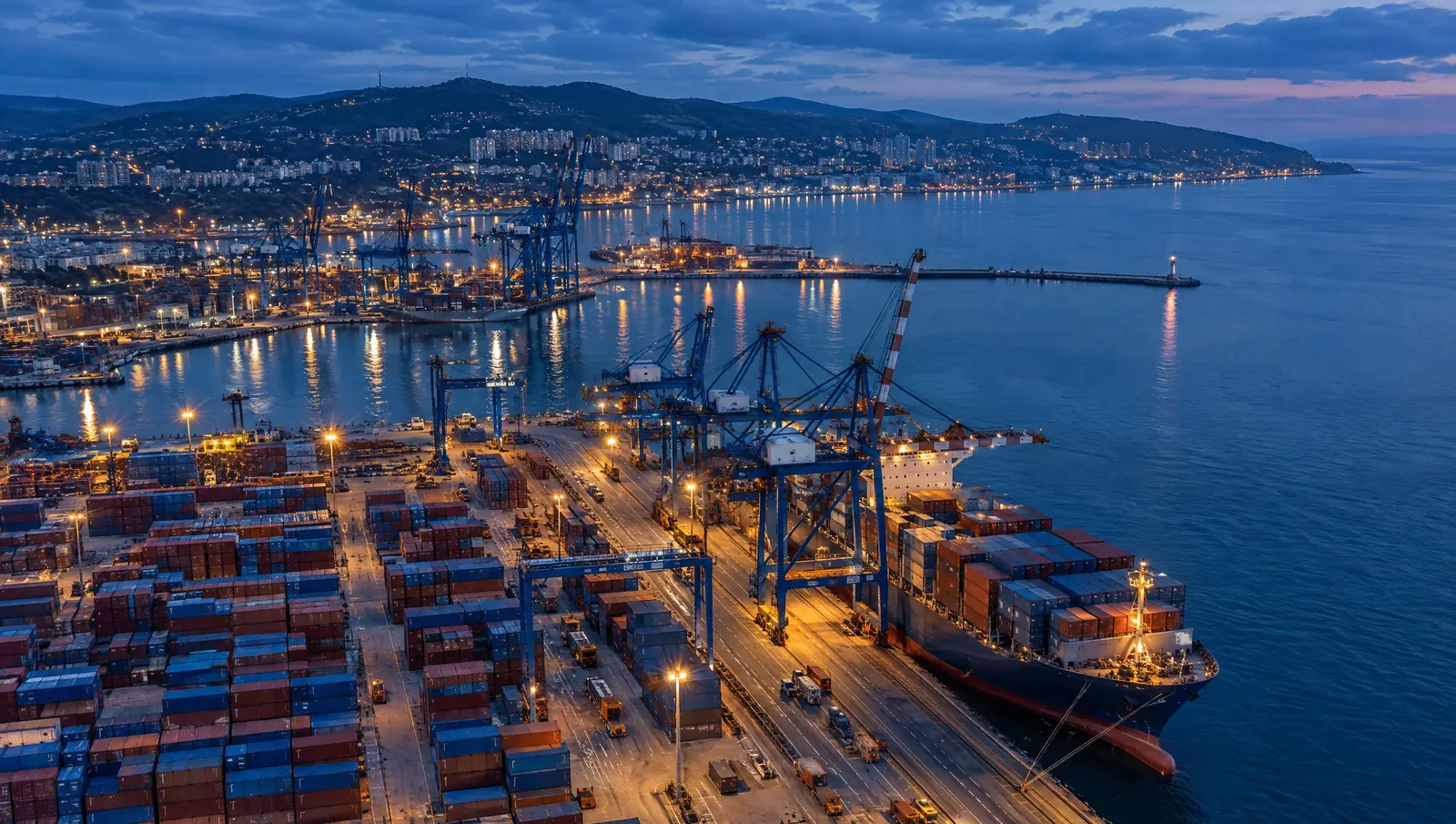
What India and Russia Actually Trade
The trade relationship is asymmetric in composition. Russia ships energy carriers, coal, fertilisers, metals, timber and machinery. India ships pharmaceuticals, organic chemicals, engineering goods, electronics, textiles, agri-products and services. Because the export basket is weighted toward commodities and the import basket toward manufactured goods, trade volumes move with energy prices and freight economics more than with any single industrial contract.
For an investor this composition determines where the opportunities sit. Commodity-linked logistics, port handling, insurance, warehousing and payment infrastructure tend to be the first places where a trading relationship creates investable business activity. Manufacturing cooperation tends to follow later, and usually only when a long-term localisation commitment is in place.
- Commodity-led trade creates demand for transport, storage, inspection and trade finance capacity
- Manufactured imports create room for local assembly and joint ventures under industrial agreements
- Service exports - IT, engineering, education, healthcare - are less visible in goods statistics but commercially significant
Payments: The Real Constraint on Trade Volume
The binding constraint on India-Russia trade is rarely demand and rarely supply. It is the plumbing: correspondent banking, currency convertibility and compliance screening. Russian exporters now receive the large majority of proceeds in rubles and currencies of friendly countries - 86% of exports by value (Bank of Russia, 2025) - which means the settlement question is mostly about which banks on each side are willing to process which currency pairs, and at what cost.
In practice, Indian and Russian counterparties use a mix of rupee-ruble arrangements, special rupee accounts held with Indian banks, and settlement in third-country currencies via intermediaries. Each route has different documentary requirements, different conversion costs and different compliance exposure. No route is universal, and availability can change with a single bank decision, which is why trade finance terms are usually renegotiated rather than fixed for multi-year periods.
- Confirm which bank on each side will actually process the payment before signing a supply contract
- Expect documentary checks on end-use, counterparty ownership and goods classification
- Take independent compliance and sanctions advice for your specific transaction - this is not something to model from general commentary
- Price in currency conversion and possible payment delay in the commercial terms
How Indian Capital Can Enter: Four Practical Routes
There is no single door. Indian capital enters through regulated market channels, through direct project equity, through special corporate regimes, and through regional incentive zones. Each route has a different approval chain and a different exit profile.
For portfolio exposure, the regulated infrastructure exists: 106 licensed investment platforms operate in Russia (Bank of Russia, May 2026), alongside the organised exchanges. For industrial projects, the special investment contract is the standard instrument - 90 such contracts have been signed, covering more than ₽2 trillion of declared investment (Government of Russia, 2025). For holding structures, special administrative regions hosted 674 companies (Ministry of Economic Development, 2025). For greenfield projects in the east, the Free Port of Vladivostok has 2,130 registered projects (KRDV, 2026), and the Arctic Zone has 1,000 residents with ₽1.1 trillion declared (KRDV, Dec 2025).
Each route carries obligations as well as benefits: localisation targets, minimum investment thresholds, reporting, and in some cases restrictions on transferring the asset before the commitment period ends. The thresholds and periods change, so they must be verified with a qualified adviser at the time of structuring.
- Portfolio: licensed brokers and investment platforms, subject to account-opening and source-of-funds checks
- Industrial: special investment contract, which typically trades tax stability for localisation commitments
- Holding: special administrative region registration for international holding structures
- Regional: Free Port of Vladivostok and the Arctic Zone, both tied to project location and performance conditions
Tax and Special Regimes: What Changes the Economics
Russia taxes corporate profit at 25%, with rates of 0-5% available inside designated special regimes (Federal Tax Service, 2025). The standard VAT rate is 22% since 1 January 2026 (Federal Tax Service, 2026). Those headline rates matter less than three structural issues: whether your project qualifies for a special regime, whether you can recover input VAT, and whether the India-Russia double taxation treaty applies cleanly to your holding structure.
The double taxation treaty position should be confirmed in writing before you commit, not after. Treaty interpretation for transactions involving intermediary jurisdictions has become more closely examined, and a structure that looks efficient on paper can produce an effective tax cost far above the headline rate if treaty benefits are challenged.
- Confirm treaty eligibility for the specific holding chain, not just the top-level jurisdiction
- Check whether the special regime you qualify for covers profit tax only or also property and social contributions
- Model VAT recovery on inputs separately from the profit tax calculation
- Rates, thresholds and regime conditions change - verify all of them at structuring stage with a tax adviser
What Is Closed or Conditioned
Some restrictions are permanent features of Russian law rather than temporary measures. Foreigners cannot own agricultural land; it can only be leased, for up to 49 years. Border areas, including Sochi, Anapa, Gelendzhik and Novorossiysk, are closed to foreign land ownership. Both rules apply regardless of the investor's country of origin.
Other restrictions are conditional. Acquisitions in sectors classified as strategic require approval under Law 57-FZ, and the review covers both the target and the acquirer's background. Investors from jurisdictions designated unfriendly face special account regimes and government approvals that do not apply to others. Currency control rules apply to cross-border transfers, including capital injections, loan repayments and dividends. None of these are obstacles to a well-prepared investment, but each one adds time - often a matter of months rather than weeks - to the transaction timetable.
- Agricultural land: lease only, up to 49 years, no freehold for foreign owners
- Border areas including Sochi, Anapa, Gelendzhik and Novorossiysk: closed to foreign land ownership
- Strategic sectors: prior government approval under Law 57-FZ
- Currency control: documentation required for inbound and outbound transfers
- Take independent legal advice on how each restriction applies to your specific structure
A Pre-Investment Checklist for Indian Groups
The sequence matters more than the individual steps. Investors who reverse the order - signing commercial terms before confirming the payment route and the tax structure - generally pay for it later in renegotiation.
A workable order is: define the asset or project, confirm the payment and repatriation route with both banks, obtain written compliance advice for the specific transaction, confirm the tax and treaty position, check land and sector restrictions, then structure the entity and only then commit capital. Each step can kill the deal, and it is cheaper to find that out early.
- Step 1 - define the target asset, project or trade flow precisely
- Step 2 - confirm settlement and repatriation with banks on both sides
- Step 3 - obtain written independent compliance and sanctions advice
- Step 4 - confirm tax, treaty and special regime eligibility
- Step 5 - check land ownership, border area and strategic sector restrictions
- Step 6 - structure the entity, obtain approvals, then commit funds
- Step 7 - build ongoing reporting and audit into the operating plan from day one
Reading the Market Signals
Several structural indicators are worth tracking if you follow Russia as an investment destination. The equity market is small relative to the economy - capitalisation was 19.5% of GDP, against a stated target of 66% by 2030 (Bank of Russia, Aug 2026) - which is a measure of how much room exists for domestic capital market growth rather than a forecast. The Bank of Russia key rate stood at 14% (Bank of Russia, Sep 2026), which shapes the cost of local borrowing and the yield demanded by local investors.
On the trade side, 75% of foreign direct investment now comes from friendly countries, up from 25% previously (UNCTAD via Izvestia, 2025) - a reorientation of capital flows rather than a growth in total volume. Retail infrastructure is digitised: 88% of retail payments are cashless (Bank of Russia, 2025). The labour force is well educated: 64% of adults aged 25 and over hold tertiary qualifications, against 50% in the United States (World Bank / UNESCO, 2021). For an Indian investor in commercial real estate, Moscow office vacancy was 7.6% (IBC Real Estate, Q2 2026), which is a tight market by international standards.
None of these figures tells you what to do. They tell you what kind of market you are looking at: a capital market that is small relative to the economy, a high rate environment, a trade flow that has already reorganised around non-Western settlement, and a skilled, urbanised workforce. That is the backdrop against which any India-Russia trade or investment decision is made. This article is general information only and is not investment, tax or legal advice; every structure described here requires independent professional review before you commit capital.
FAQ
Can an Indian company open a bank account in Russia?
In principle yes, but in practice it depends on the specific bank, the company's activity and the documentary package. Russian banks apply their own onboarding and compliance screening, and the requirements change. The reliable approach is to confirm account-opening feasibility with the specific bank before signing any commercial contract that depends on it, and to take independent compliance advice for your case.
Is the rupee-ruble settlement mechanism actually working?
It works in the sense that a large share of Russian export proceeds is now received in rubles and friendly-country currencies - 86% by value (Bank of Russia, 2025). But settlement is not a single mechanism: it is a patchwork of bank-level arrangements with different currency pairs, documentary requirements and costs. Availability can change quickly, so payment terms should be renegotiable rather than fixed for long periods.
Can an Indian investor buy Russian shares?
Portfolio access exists through licensed brokers and regulated investment platforms - 106 licensed investment platforms operated in Russia as of May 2026 (Bank of Russia). Practical access depends on account-opening requirements, source-of-funds documentation, currency conversion and repatriation routes, all of which should be confirmed with the specific intermediary before you rely on them.
Can an Indian company own land in Russia?
Two hard restrictions apply to foreign owners. Agricultural land cannot be owned by foreigners - it can only be leased, for up to 49 years. Border areas, including Sochi, Anapa, Gelendzhik and Novorossiysk, are closed to foreign land ownership. Other land categories are generally available, subject to local rules and to how the property is zoned.
What approvals are needed for a strategic sector investment?
Acquisitions in sectors classified as strategic require prior government approval under Law 57-FZ, and the review considers both the target and the acquirer. Investors from jurisdictions designated unfriendly face additional account regimes and approvals. Timelines extend by months. Because the classification of sectors and the procedural requirements change, confirm the position with a qualified legal adviser before negotiating.
Information on this website is not an offer or an individual investment recommendation. Investing involves risk, including the loss of all invested capital. Investing via investment platforms is high-risk and may result in the loss of the entire investment. Figures are sourced from third parties and dated. Investors must comply with the laws of their jurisdiction.