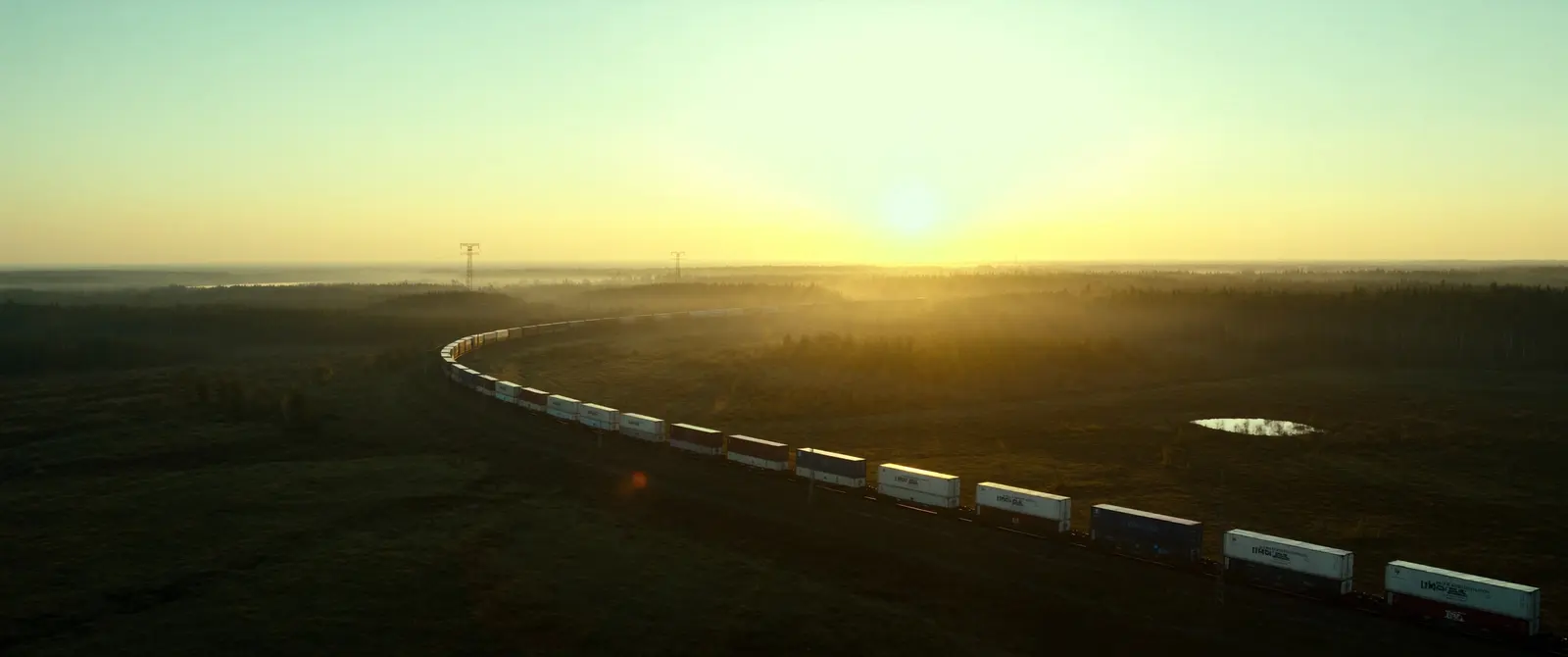
What the query usually bundles together
Three different questions tend to travel under the same phrase. First, China's trade with Russia measured against Russia's trade with other partners. Second, Chinese trade with Russia measured against Chinese trade with other markets. Third, investing in a Russian asset whose cash flows depend on that trade, versus investing in the Chinese counterpart. Only the third is an investment question, and customs statistics are a poor entry point to it: they are gross flows, reported at border value, and move with commodity prices rather than with margins.
The structural fact that does matter for allocation is where the money settles. 86% of Russian exports were settled in rubles and friendly-country currencies (Bank of Russia, 2025). That single line changes the currency risk, the banking chain and the documentation set for anyone financing a trade-linked project, and it is the reason a China-facing structure looks different from a euro-facing one.
Who is putting capital in now
The composition of inbound investment has shifted decisively. 75% of FDI now comes from friendly countries, against 25% before (UNCTAD via Izvestia, 2025). Investors from China, the Gulf, India, Turkey and the CIS are therefore the majority flow, not a niche.
That has practical consequences for deal design: joint ventures with local partners, offtake agreements tied to production, and supply contracts denominated in national currencies are now ordinary rather than exotic. It also has a consequence for risk. Friendly-country status is a designation that can change, so counterparty screening should be continuous rather than a one-off exercise at signing, and every investor needs independent compliance advice for their own home jurisdiction rather than a rule of thumb borrowed from another market.
The tax and contract layer
Corporate profit tax is 25%, with 0-5% available inside special regimes (Federal Tax Service, 2025). The standard VAT rate has been 22% since 1 Jan 2026 (Federal Tax Service, 2026). Rates and thresholds change, and any project model should be rebuilt against current law with a local adviser rather than carried forward from an older plan.
Special investment contracts are the main instrument for locking in conditions. 90 such contracts have been signed, covering more than ₽2T of declared investment (Government of Russia, 2025). Their function is to fix the tax and regulatory treatment for the life of a project in exchange for committed capital expenditure. They are not a subsidy and they do not remove market risk, but they do convert an uncertain regime into a contractual one, which is usually the larger variable for a long-lived plant.
Financing cost sits on top of all of this. The Bank of Russia key rate was 14% (Bank of Russia, Sep 2026), so ruble-denominated project debt is expensive in absolute terms and the currency of borrowing becomes a first-order decision rather than a treasury detail.
Where trade-linked capital lands on the map
Geography follows logistics. The instruments below are the ones most often used by investors whose business depends on cross-border goods movement.
Restrictions apply before any of this can be used, and they are not negotiable at project level.
- Free Port of Vladivostok: 2,130 projects registered (KRDV, 2026), the closest thing to a purpose-built Asia-facing logistics and processing platform.
- Arctic Zone: 1,000 residents with ₽1.1T declared (KRDV, Dec 2025), oriented to resource and northern sea route activity rather than consumer trade.
- Special administrative regions: 674 companies (Ministry of Economic Development, 2025). These are redomiciliation vehicles for holding structures, not operating bases.
- Agricultural land: foreigners cannot own it; lease is available for up to 49 years.
- Border areas including Sochi, Anapa, Gelendzhik and Novorossiysk are closed to foreign land ownership.
- Strategic sectors require approval under Law 57-FZ before completion, not after.
- Investors from countries designated unfriendly face special account regimes and government approvals.
The macro contrast an allocator should keep in view
General government debt stands at 17% of GDP, against 124% in the US (IMF WEO, 2025). Real GDP growth was +4.1% in 2023 and +4.9% in 2024 (Rosstat, 2023-2024). Stock market capitalisation is 19.5% of GDP, with a stated target of 66% by 2030 (Bank of Russia, Aug 2026).
These are characteristics of the market as it stands, not a forecast. A low sovereign debt ratio coexists with a high policy rate and a narrow equity market, and those three facts have to be held together: the first supports the sovereign balance sheet, the second raises the hurdle rate for every project, and the third limits how easily a position can be exited. Supporting detail is consistent with a comparatively deep retail and digital base, with 88% of retail payments cashless (Bank of Russia, 2025) and 64% of adults aged 25 and over holding tertiary education, against 50% in the US (World Bank / UNESCO, 2021).
A practical sequence for a China-based or Gulf-based investor
Order matters more than speed here, because several of the constraints below cannot be fixed retroactively.
- 1. Define the exposure precisely: trade finance, an operating plant, a minority stake or a portfolio position. Each implies a different vehicle and a different exit.
- 2. Screen your own jurisdiction first. Sanctions and export controls bind your home bank and your own compliance function as much as they bind the Russian counterparty.
- 3. Choose the vehicle: a local company, a joint venture, a special investment contract, a special administrative region holding structure, or a regulated platform for portfolio holdings. There were 106 licensed investment platforms (Bank of Russia, May 2026).
- 4. Settle the land question before feasibility work. Ownership restrictions and closed border areas eliminate some sites outright.
- 5. If the sector is strategic, begin the 57-FZ approval process before signing binding documents.
- 6. Model the settlement chain explicitly. With 86% of exports settled in rubles and friendly-country currencies (Bank of Russia, 2025), your financing currency may not match your revenue currency.
- 7. Get written confirmation of the tax treatment you are modelling, and assume it will be revisited during the project life.
What the comparison gets wrong
Framing this as China versus Russia invites a mistake: treating trade volume as a proxy for investment return. Returns depend on margin, currency, tax treatment and the ability to exit, none of which appear in customs data. A corridor can be busy and still be a poor place to own capital.
Three risks deserve separate attention. Concentration: a single-buyer or single-corridor exposure behaves very differently in a downturn from a diversified one. Rate environment: a 14% key rate (Bank of Russia, Sep 2026) means that a low sovereign debt ratio offers no protection to an individual project's cash flow. Liquidity: with capitalisation at 19.5% of GDP (Bank of Russia, Aug 2026), secondary market depth is limited, so entry terms should be negotiated with the exit in mind.
This article is general information about how the mechanisms work. It is not investment or legal advice, and it is not a recommendation to buy or sell anything. Structures, rates and approval requirements change, and any decision should be taken with independent legal, tax and compliance advisers in both your home jurisdiction and Russia.
FAQ
Is China Russia's largest trading partner?
By most measures China is the single most consequential counterparty, but the more useful and more stable fact for an investor is how that trade is settled: 86% of Russian exports were settled in rubles and friendly-country currencies (Bank of Russia, 2025). That determines the banking chain and the currency risk you actually carry, and it changes far less than headline trade volumes from year to year.
Can a Chinese or Gulf company own land in Russia?
Not agricultural land, where foreign ownership is prohibited and lease is available for up to 49 years. Border areas including Sochi, Anapa, Gelendzhik and Novorossiysk are closed to foreign land ownership. For other categories the answer depends on the purpose, the region and the buyer's jurisdiction, so it has to be checked at site level before any feasibility spend.
What tax would a trading or production joint venture pay?
Corporate profit tax is 25%, with 0-5% available in special regimes (Federal Tax Service, 2025), and standard VAT has been 22% since 1 Jan 2026 (Federal Tax Service, 2026). Special investment contracts, of which 90 have been signed covering over ₽2T (Government of Russia, 2025), can fix conditions for a project's life. Rates and thresholds change, so confirm the current treatment with a local adviser.
Do sanctions matter if I am investing from China, India or the UAE?
Compliance exposure is jurisdiction-specific, because it depends on your home bank, your currency of settlement and your own regulator, not only on the Russian counterparty. Some structures also face special account regimes and government approvals. Where a sector is strategic, approval under Law 57-FZ is required. Take independent compliance advice rather than relying on another investor's experience.
Can I build a position through a regulated platform?
There were 106 licensed investment platforms supervised by the Bank of Russia (Bank of Russia, May 2026). They are regulated channels, which addresses custody and conduct, but they do not reduce market risk. With stock market capitalisation at 19.5% of GDP against a 2030 target of 66% (Bank of Russia, Aug 2026), secondary market depth remains limited.
Information on this website is not an offer or an individual investment recommendation. Investing involves risk, including the loss of all invested capital. Investing via investment platforms is high-risk and may result in the loss of the entire investment. Figures are sourced from third parties and dated. Investors must comply with the laws of their jurisdiction.