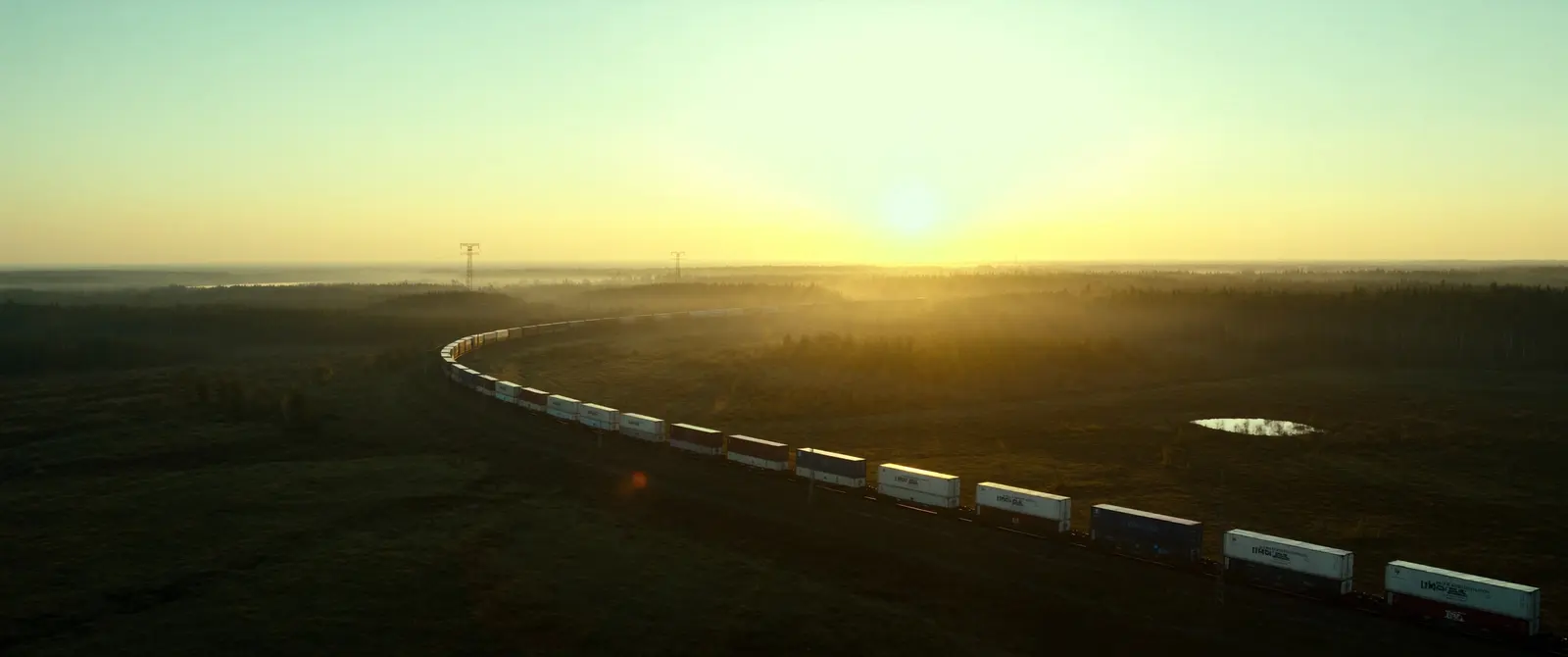
The shape of the trade flow in 2024
China is Russia's largest single trading partner, and Russia is a mid-sized partner for China - the relationship is far more important to one side than to the other. That asymmetry shapes everything: Russian buyers are price-sensitive and increasingly dependent on Chinese supply for machinery, vehicles, components and consumer goods, while Chinese suppliers treat Russia as one market among many and manage it with heightened compliance caution.
The 2024 expansion rode on Russian domestic demand: real GDP grew 4.9% in 2024 after 4.1% in 2023 (Rosstat, 2023-2024), with investment and consumer spending both contributing. That is the demand base Chinese exporters are selling into.
On the Russian export side, the mix remains concentrated: hydrocarbons, metals including palladium - Russia is the world's number one producer at 44% of global supply (USGS, 2025) - fertilisers, grain and timber. On the Chinese export side, the fastest-growing lines have been road vehicles, construction and agricultural machinery, industrial equipment, electronics and components.
- Russia sells: energy, metals, fertilisers, food, timber - commodity-heavy and price-taker
- China sells: machinery, vehicles, electronics, components, consumer goods - higher value-added, faster growth
- The imbalance is not only in value but in dependency: Russia needs the channel more than China needs the market
Payments are the real bottleneck
Settlement has been the binding constraint on trade since 2022, more than tariffs or logistics. Russia has shifted the bulk of its external trade out of dollars and euros: 86% of Russian exports are settled in rubles and friendly-country currencies (Bank of Russia, 2025). For China-facing trade, the yuan is the natural unit on both sides of the contract, and ruble-yuan pairs are now routine.
The difficulty is not the currency, it is the correspondent chain. Many Russian banks carry blocking sanctions, which means a Chinese bank handling a Russian payment runs its own risk assessment, and its correspondent banks in third countries run theirs. In practice this produces longer routes, more documentation, occasional multi-week delays and, in some cases, a refusal to onboard an otherwise solvent counterparty. Deals that look profitable on paper can stall purely on payment infrastructure.
Practical consequences for a Chinese exporter: budget for longer cash cycles, price the working-capital cost into the contract, and pre-clear both your own bank and its correspondents before signing. Documentary instruments such as letters of credit are less useful than they once were, because confirmation depends on banks that may decline the exposure.
This article does not describe routes around sanctions or payment restrictions, and investors should not treat any general description as a workaround. Payment structuring requires independent compliance and legal advice in your own jurisdiction.
- Settlement currency: ruble and friendly-country currencies dominate Russian export receipts (Bank of Russia, 2025)
- Risk sits with your bank and its correspondents, not only with your buyer
- Pre-clear the payment route before fixing price and delivery terms
- Get your own sanctions and AML counsel; never rely on a counterparty's assurances
Who is on the other side of the table
The Russian import market for Chinese goods is served by three broad channels: large state-linked industrial buyers procuring equipment directly, private distribution groups holding brand rights, and a long tail of small trading companies that import containers and sell domestically. The third group is the easiest to onboard and the hardest to credit-check; the first is slow, tender-driven and documentation-heavy but more predictable once qualified.
On the Chinese side, exporters typically operate through a Russian subsidiary, a local distributor or a trading intermediary. Each structure has a different tax and currency-control profile. A Russian subsidiary gives control over customs, certification and ruble collection, but brings Russian accounting, currency-control reporting and profit-repatriation rules into scope.
For companies thinking beyond pure trade, Russia's Far East is the geographically obvious entry point given proximity to northeast China. The Free Port of Vladivostok counts 2,130 projects (KRDV, 2026) and the Arctic Zone has 1,000 residents with ₽1.1T declared (KRDV, Dec 2025) - these are established regimes with published procedures, though approval and eligibility are case-specific.
Rules and limits a Chinese counterpart must know
China is not on Russia's list of unfriendly countries, which keeps Chinese investors out of the special account regimes and government approval requirements that apply to investors from those jurisdictions. That does not remove approval requirements that apply to everyone.
Foreign investment in strategic sectors requires clearance under Law 57-FZ, and the list of covered activities is broad - it reaches beyond defence into energy, transport infrastructure, communications, large-scale extraction and some manufacturing. Screening is a condition precedent, not a formality, and it can take months.
Land and real estate carry hard limits regardless of nationality of the investor. Foreigners cannot own agricultural land in Russia; the maximum is a lease of up to 49 years. Border areas, including Sochi, Anapa, Gelendzhik and Novorossiysk, are closed to foreign land ownership. Any transaction touching land should be verified against current regional restrictions before money moves.
Tax rates matter to the deal economics: corporate profit tax is 25%, with 0-5% available inside special regimes (Federal Tax Service, 2025), while the standard VAT rate is 22% since 1 January 2026 (Federal Tax Service, 2026). Rates and thresholds change; confirm the position in force at the date of your transaction with a Russian tax adviser.
- Strategic sectors: approval under Law 57-FZ, months of lead time
- Agricultural land: no foreign ownership, lease up to 49 years
- Border areas including Sochi, Anapa, Gelendzhik and Novorossiysk: closed to foreign land ownership
- Profit tax 25%, 0-5% in special regimes (FTS, 2025); standard VAT 22% from 1 Jan 2026 (FTS, 2026)
From trade to investment: where the two meet
The clearest shift in the last few years is that Chinese firms no longer only ship finished goods. Localisation pressure, logistics cost and tariff and certification friction are pushing assemblers and suppliers to establish production inside Russia. Foreign direct investment has reoriented accordingly: 75% of FDI now comes from friendly countries, against 25% before (UNCTAD via Izvestia, 2025).
The instruments designed for exactly this step are special investment contracts - 90 of them covering ₽2T+ of investment (Government of Russia, 2025) - which lock in tax and regulatory conditions for the life of a project in exchange for localisation commitments. Special administrative regions, with 674 companies registered (Ministry of Economic Development, 2025), serve a different purpose: redomiciling corporate structures, not building plants.
The trade-off is straightforward. A localised plant raises your fixed cost base in a market with a high cost of capital and currency risk; it also reduces dependence on cross-border payment chains that are the single most fragile part of the business today. That trade-off, not the headline growth rate, is the real decision for a Chinese industrial investor.
Cost of money and what it does to margins
Ruble financing is expensive. The Bank of Russia key rate stands at 14% (Bank of Russia, Sep 2026), which sets the floor for working-capital and investment lending in rubles. Yuan funding is typically cheaper but shifts the currency risk onto the Russian counterparty, who may price it back into the deal or refuse it. Any payment-term negotiation is really a negotiation about who carries that cost.
On the capital side, Russia's equity market remains small relative to the economy - capitalisation is 19.5% of GDP against a target of 66% by 2030 (Bank of Russia, Aug 2026) - so exit routes through public markets are limited for a foreign industrial investor. Private sales to strategic buyers are the realistic path, and that affects how you structure from day one. Regulated investment platforms, 106 licensed as of May 2026 (Bank of Russia), are a channel for portfolio allocation, not a substitute for direct investment infrastructure.
Domestic payments infrastructure is mature: 88% of retail payments are cashless (Bank of Russia, 2025). That matters more than it sounds - it means a Chinese entrant selling consumer goods into Russia can operate on modern retail and e-commerce rails rather than cash logistics.
A working sequence for a Chinese exporter or investor
The order matters, because the expensive mistakes happen at the start.
- Step 1 - Classify the goods and check export-control and import-control exposure on both sides, with counsel.
- Step 2 - Qualify the Russian counterparty: ownership, sanctions status, litigation history, VAT registration and customs record.
- Step 3 - Settle the currency and pre-clear the payment route with your bank and its correspondents before agreeing terms.
- Step 4 - Fix the contract: Incoterms, currency and revaluation clause, payment schedule, governing law and arbitration seat, testing and acceptance, force majeure language that reflects payment reality.
- Step 5 - Handle certification and customs: EAC conformity requirements, labelling, HS classification, customs valuation.
- Step 6 - Decide the operating structure: direct export, distributor, Russian subsidiary or localised production, and register for tax accordingly.
- Step 7 - Plan repatriation and reporting before the first invoice, not after the first profit.
- Step 8 - Re-verify rates, thresholds and restrictions at the date of the transaction; they change and this article is not a substitute for advice.
FAQ
Is China Russia's largest trading partner?
Yes. China is Russia's largest single trading partner by a wide margin, while Russia represents a much smaller share of China's total trade. That asymmetry means the relationship is more strategically important to Russia than to China, which affects negotiating leverage and the attention each side's banks give to compliance.
Can Chinese companies settle trade in yuan?
Yes, and yuan settlement is now standard across much of China-Russia trade. Russia has moved the bulk of its external trade into rubles and friendly-country currencies - 86% of exports as of 2025 (Bank of Russia). The constraint is rarely the currency itself but the correspondent banking chain, since some Russian banks face blocking sanctions and Chinese banks apply their own due diligence.
Can a Chinese company own land or a factory in Russia?
Foreigners cannot own agricultural land in Russia and may hold it on lease for up to 49 years. Border areas including Sochi, Anapa, Gelendzhik and Novorossiysk are closed to foreign land ownership. Industrial property is generally acquirable, but investment in strategic sectors requires approval under Law 57-FZ, which can take months.
Why do payments between China and Russia take so long?
Because the delay is generated by compliance, not by technology. A Chinese bank handling a Russian payment runs its own sanctions and AML assessment, and its correspondent banks run theirs. The result is longer routes, heavier documentation and, in some cases, refusal to onboard solvent counterparties. Pre-clearing the route before signing a contract is the single most useful step an exporter can take.
Does the 22% VAT rate affect importers in 2026?
The standard VAT rate is 22% from 1 January 2026 (Federal Tax Service, 2026), and import VAT is generally payable at customs, with recovery rules depending on your registration and the nature of the goods. Rates and exemptions change, so confirm the treatment in force for your specific transaction with a Russian tax adviser.
Information on this website is not an offer or an individual investment recommendation. Investing involves risk, including the loss of all invested capital. Investing via investment platforms is high-risk and may result in the loss of the entire investment. Figures are sourced from third parties and dated. Investors must comply with the laws of their jurisdiction.