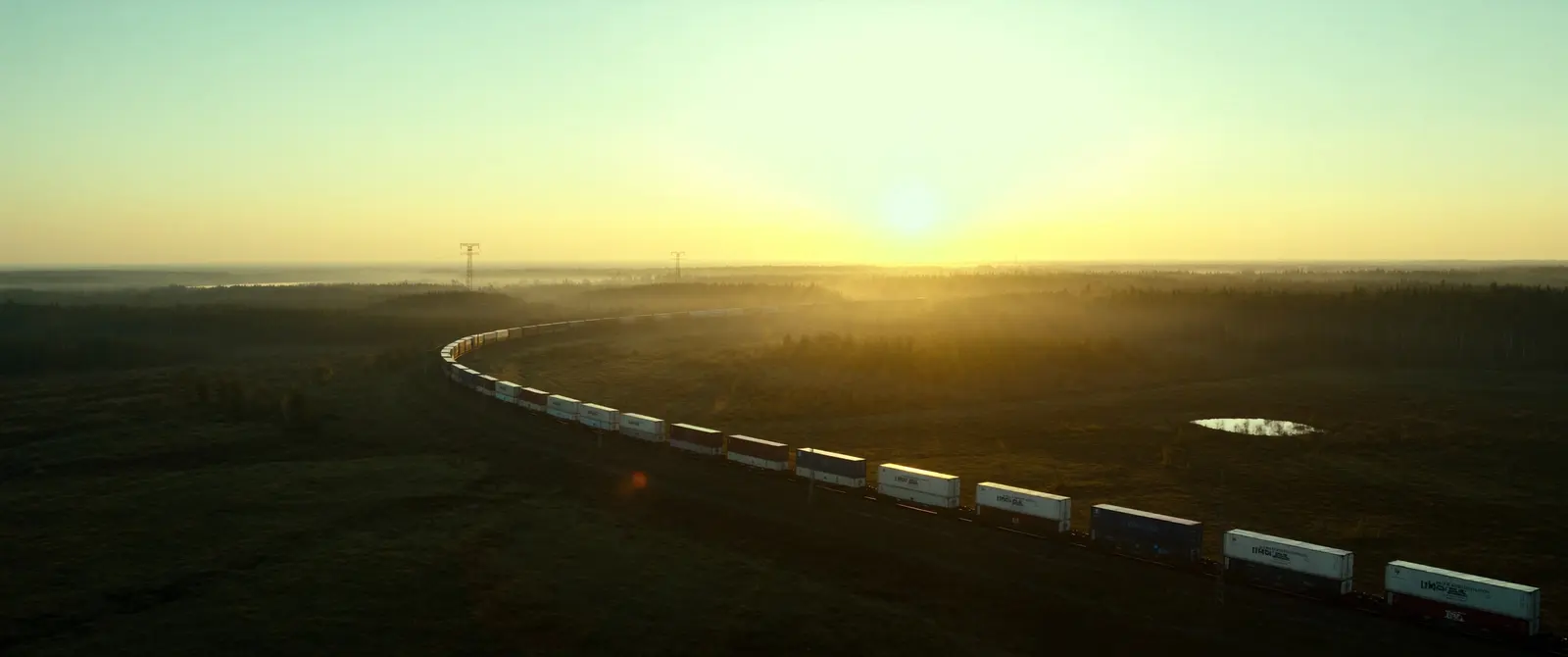
Where Suifenhe sits in the car corridor
Suifenhe is the Chinese half of a border pair. On the Russian side the crossing is Pogranichny, in Primorsky Krai, with the Grodekovo rail station behind it and Vladivostok further on. Behind Suifenhe lies the Chinese automotive belt of Heilongjiang, Jilin and Liaoning, and beyond it the plants of eastern and central China. Ahead lies the Russian Far East, and from there the Trans-Siberian route west.
The city's role is physical, not financial. Its border economic cooperation zone, bonded logistics capacity and cross-border e-commerce infrastructure exist to move goods across a frontier where the rail gauge changes from the Chinese standard to the Russian 1520 mm network. Containers and vehicles are transloaded, inspected and re-documented before they travel onward.
Two practical consequences follow. First, Chinese domestic cars are left-hand drive, the same as in Russia, so no steering conversion is needed - unlike the used Japanese imports that dominated the Russian Far East for years. Second, because transloading happens at the border, the quality of the receiving yard, the condition of the vehicles on arrival and the speed of documentation are operational variables you can actually manage.
- Chinese side: Suifenhe, Heilongjiang province. Russian side: Pogranichny, Primorsky Krai.
- Rail: gauge break at the border, so transloading is inherent to the route.
- Road: auto carriers and container trucks clear directly at the crossing.
- Downstream Russian regime: the Free Port of Vladivostok, which reported 2,130 projects (KRDV, 2026) and offers tax and administrative conditions on the Russian side of the border.
The order of steps for a commercial import
A commercial import is a chain of documents, and the order matters because some steps can only be done before shipment. The usual sequence in this corridor runs as follows.
Conformity comes first. A vehicle placed on the Russian market must meet Eurasian Economic Union technical regulations for wheeled vehicles. That means conformity documents - typically a vehicle type approval for a model line or a vehicle design safety certificate for units and small batches - plus, for vehicles put into circulation, an emergency call device compatible with the Russian ERA-GLONASS system. Obtaining these after the car has arrived is possible but expensive, and some configurations simply cannot be certified.
Then the commercial layer: contract, specification, Incoterms, payment route and currency. Russian trade settlement has moved heavily toward rubles and currencies of friendly countries - 86% of exports were settled that way (Bank of Russia, 2025) - and import payment structures have followed the same direction. Payment route, not price, is the most common cause of delay in this corridor.
Then export clearance on the Chinese side, the border crossing itself, and Russian customs, where the declaration is filed electronically, duties, VAT and the utilisation fee are assessed, and the vehicle is released. After release comes pre-delivery inspection and adaptation, then registration with the traffic police if the car is to be used or sold inside Russia, then onward logistics.
- Sequence: conformity documents - contract and payment route - Chinese export clearance - border crossing and transloading - Russian customs declaration and fee assessment - release - PDI and adaptation - registration or onward dispatch.
- Conformity is the step most often underestimated: it constrains which models and trims can be brought in at all.
- Customs declaration on the Russian side is electronic and can be filed by the importer or a customs representative.
- Registration requires the vehicle to be placed into circulation legally, which means the conformity and fee steps must be complete before, not after.
What the landed cost is actually made of
Buyers new to the route often compare the Chinese ex-works price with a Russian retail price and conclude the margin is obvious. It is not, because the landed cost is a stack of layers, each of which can move.
The stack includes the vehicle price, freight and transloading at the border, customs duty under the EAEU common customs tariff, import VAT, the utilisation fee, excise where the category applies, certification cost, PDI and adaptation, storage and inland transport. Standard VAT is 22% since 1 January 2026 (Federal Tax Service, 2026). Customs duty rates and, in particular, the utilisation fee are policy variables that have been changed repeatedly with limited notice, and they differ by engine size, power and whether the import is personal or commercial.
If you set up an operating company in Russia rather than importing as an individual, corporate profit tax is 25%, with rates of 0-5% available in certain special regimes (Federal Tax Service, 2025). Special investment contracts - 90 signed, covering more than RUB 2 trillion of investment (Government of Russia, 2025) - are relevant to industrial projects, not to ordinary vehicle trading.
- Layers: vehicle price, freight and border transloading, duty, VAT (22% standard since 1 Jan 2026), utilisation fee, excise where applicable, certification, PDI and adaptation, storage, inland transport.
- Duty rates and the utilisation fee change; any figure quoted to you more than a few months old should be re-verified with a customs adviser.
- Personal-use imports and commercial imports are assessed differently, which is why the two channels produce different prices for the same car.
- Margin analysis should be done on a landed-cost model per unit, not per shipment.
Personal import versus the commercial channel
The personal-use channel exists because individuals may import a car for their own use under a simplified declaration. It has conditions - on frequency, on resale timing and on the fee basis - and those conditions have been tightened more than once. Treat the current limits as something to confirm with a customs adviser before shipping, not as a fixed rule.
The commercial channel is the one that supports a business: a legal entity imports, declares, certifies and sells, and issues the buyer a document trail that survives resale. The gap between the two channels is where most of the risk in this trade sits.
Cars brought in through informal arrangements may be cheaper on the day and more expensive later: registration can be refused, the resale value drops because the history is unclear, and there is no warranty or recall coverage. When a government changes the fee basis, informal positions are the ones that lose money first.
- Personal-use: simplified declaration, conditions on frequency and resale, fee basis differs from commercial.
- Commercial: full declaration, conformity documents in the entity's name, warranty and recall coverage, clean resale history.
- Red flag: a seller who cannot show the customs declaration and the conformity documents in the name of the entity that took payment.
- Red flag: prices that are only explainable by a fee basis that the seller cannot document.
Why this corridor grew, and what it now carries
The route grew because supply and demand were re-routed at the same time. As established foreign brands reduced or ended Russian operations, Chinese manufacturers moved into the gap, and a distribution layer - importers, dealer groups, parts wholesalers, service networks - had to be built around them. Suifenhe and the Primorsky Krai crossings became one of the natural pipes for that flow because they are close to the plants, close to the Russian Far East consumer market and connected to the national rail network.
What moves through the corridor has also broadened. It is no longer only finished passenger cars: it includes electric vehicles, light commercial vehicles, trucks, buses, components and aftermarket parts. Each of those categories has its own conformity path and its own fee treatment, and electric vehicles in particular sit under a fee framework that has been adjusted separately from combustion cars.
Russian demand conditions support the trade: real GDP grew 4.1% in 2023 and 4.9% in 2024 (Rosstat). Household cashless payment penetration - 88% of retail payments (Bank of Russia, 2025) - also means consumer-facing car businesses can operate with normal digital payment infrastructure rather than cash handling.
- Categories moving through: passenger cars, electric vehicles, LCVs, trucks, buses, components, aftermarket parts.
- Electric vehicles and combustion vehicles are treated differently in fee and certification terms.
- Distribution is still being built, which is where service and parts businesses find room.
- Context: the stock market capitalisation of the Russian market was 19.5% of GDP with a 66% target by 2030 (Bank of Russia, Aug 2026) - relevant if you are thinking about how these businesses will eventually be financed.
Where an outside investor can realistically participate
The most accessible positions in this corridor are services around the flow rather than ownership of the flow. Trading finished cars requires working capital, customs expertise, currency management and a dealer network; providing the infrastructure the traders need requires less of all four.
Among the service positions: bonded and non-bonded warehousing near the crossing, pre-delivery inspection and adaptation workshops, customs brokerage, cross-border road transport, parts distribution and warehousing, leasing and factoring for dealers, and the software layer that tracks declarations, fee payments and vehicle status across two jurisdictions.
The commercial logic of each is different and none is a promise of return. Warehousing is a real-estate business with a tenant-risk profile; PDI is an operating business with labour and throughput risk; brokerage is a licensing and compliance business; leasing is a credit business and is sensitive to the cost of money - the Bank of Russia key rate stood at 14% (Bank of Russia, Sep 2026), which makes ruble funding expensive. Choose on the basis of what you can actually supervise on the ground.
On the Russian side of the border, the Free Port of Vladivostok and the Arctic Zone regimes - the latter with 1,000 residents and RUB 1.1 trillion declared (KRDV, Dec 2025) - offer tax and administrative conditions for qualifying projects. Qualification is specific and must be checked against the current rules, not against a summary.
- Lower-capital entry: PDI and adaptation, warehousing, brokerage, inland transport, parts.
- Higher-capital entry: importing and distributing vehicles, leasing and dealer finance.
- Each regime (Free Port of Vladivostok, Arctic Zone, special administrative regions) has its own qualifying criteria and its own reporting obligations.
- Special administrative regions hosted 674 companies (Ministry of Economic Development, 2025) - a structure relevant to holding and corporate functions rather than to car logistics.
Compliance, payment and the risks that actually bite
Sanctions are a compliance matter, not a commercial one, and they are handled before contracts, not after. Banks, insurers, freight forwarders and shipowners apply their own screening. Different jurisdictions impose different restrictions, and the export of certain vehicle categories from certain countries to Russia may be restricted. Whether your specific transaction, your bank and your logistics provider can handle this route is a question for independent compliance counsel in your own jurisdiction. Nothing in this article should be read as guidance on avoiding restrictions.
The operational risks are more mundane and more likely to cost you money. Fee and duty rules change with little notice and can apply to cars already in transit. Ruble and yuan exchange rates move. Vehicles can sit at the border for reasons unrelated to you. Customs valuation disputes are common when declared values look low. And a counterparty who cannot produce documents in the name of the entity that received the money is a counterparty you cannot enforce against.
Two structural points are worth remembering. Foreigners cannot own agricultural land in Russia and can only lease it for up to 49 years; several border areas, including Sochi, Anapa, Gelendzhik and Novorossiysk, are closed to foreign land ownership - so a warehousing plan needs an ownership and structuring review, not just a lease negotiation. Investors from countries designated unfriendly face special account regimes and government approvals, and acquisitions in strategic sectors require approval under Law 57-FZ. If your holding structure sits in such a jurisdiction, assume the banking and approval questions will take longer than the commercial ones.
- Check first: whether your bank, insurer and forwarder will handle the route at all.
- Fee and duty changes can apply to goods already shipped; build that into pricing.
- Customs valuation disputes are a recurring cost in this trade.
- Land: foreigners cannot own agricultural land (lease up to 49 years); certain border areas are closed to foreign land ownership.
- Unfriendly-jurisdiction investors: special account regimes and government approvals apply; strategic sectors need approval under Law 57-FZ.
- This is general information, not investment or legal advice. Verify every rate, threshold and requirement with a qualified adviser before acting.
FAQ
Is Suifenhe the only route for Chinese cars into Russia?
No. There are several crossings between north-east China and the Russian Far East, plus sea routes through Vladivostok and, for the western part of Russia, deep-sea container services. The right choice depends on the destination city, the vehicle category, the certification path and the current cost of each option. Suifenhe is one established node, not a monopoly.
Do Chinese cars need steering conversion for Russia?
No. China and Russia both use left-hand drive, so a Chinese domestic model can be placed on the Russian market without conversion. That is a structural cost advantage over used Japanese imports, which require conversion work. Conformity, emergency call system compatibility and fee treatment still apply.
Can an individual buy a car in China and import it personally?
Personal-use import exists under a simplified declaration, but the conditions - on frequency, resale timing and the fee basis - have been tightened repeatedly. Treat the current limits as something to confirm with a customs adviser before you ship, and note that cars imported this way generally have weaker resale documentation than commercially imported ones.
What documents should I expect to see from a seller?
At minimum: the customs declaration showing the vehicle was cleared and the fees paid, the conformity documents for the model or unit, the purchase documents, and proof of the emergency call system installation where required. If those documents are in a different name from the entity that took your money, the transaction is difficult to enforce.
How long does the whole process take?
It varies too widely to quote a figure responsibly. It depends on the conformity route chosen, the payment channel, border queues, customs queries and inland transport. Plan on the certification and payment steps, not the driving distance, being the critical path.
Information on this website is not an offer or an individual investment recommendation. Investing involves risk, including the loss of all invested capital. Investing via investment platforms is high-risk and may result in the loss of the entire investment. Figures are sourced from third parties and dated. Investors must comply with the laws of their jurisdiction.