What the current pipeline actually consists of
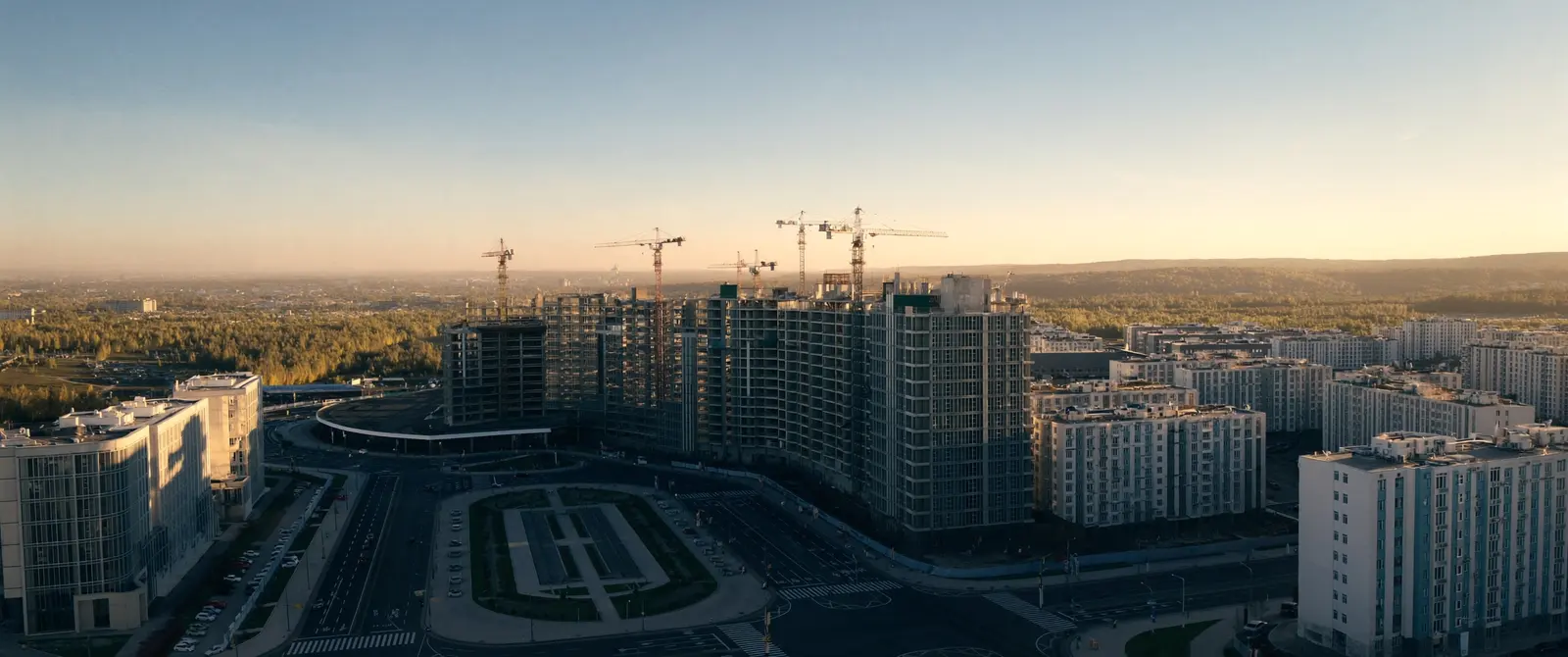
The most active segments are warehouses and logistics, industrial and agro-processing plants, transport and utility infrastructure, and a smaller volume of office and residential work in the largest cities. Office demand is the easiest part of the market to read: Moscow office vacancy stood at 7.6% in Q2 2026 (IBC Real Estate), which tells you the market is neither starved nor obviously oversupplied.
Macro context matters for underwriting. Real GDP grew 4.1% in 2023 and 4.9% in 2024 (Rosstat), and general government debt was 17% of GDP against 124% in the US (IMF WEO, 2025). That combination supports domestic construction demand but says nothing about any individual project's viability.
Trade reorientation is visible in the settlement data: 86% of exports were settled in rubles and friendly-country currencies (Bank of Russia, 2025), and 75% of FDI now comes from friendly countries against 25% before (UNCTAD via Izvestia, 2025). Practical consequence: tenants and end-users for new industrial and warehouse space are increasingly non-Western, and so are the contractors and equipment suppliers you will be dealing with.
- Warehouse and logistics parks near Moscow, St Petersburg, the Volga region and the Urals
- Industrial and agro-processing plants, often tied to import substitution or export processing
- Transport, utility and energy infrastructure concessions and regulated contracts
- Office and mixed-use schemes in the largest cities, where vacancy data is published
- Residential, mostly as a local-market business with project finance from Russian banks
The approval chain, in the order it actually runs
Russian construction regulation is federal in framework and local in execution. The sequence below is the standard path; large industrial objects can be shifted to federal-level review, and each region adds its own requirements and fees.
Step 1 is land rights: a lease (from a municipality after an auction, or from a private owner) or ownership where the law permits it. Step 2 is the urban planning plan of the land plot, known as the GPZU, issued by the local authority; it fixes what you may build and how high. Step 3 is design documentation and engineering surveys. Step 4 is expert review of that documentation, state or non-state depending on the object. Step 5 is the construction permit, issued by the local authority, after which state construction supervision begins on site. Step 6 is the commissioning permit, and step 7 is cadastral registration and registration of ownership.
Where a project is large enough, the practical shortcut is to obtain the status of a scale investment project under regional law. That status can give you a land plot without an auction, infrastructure connection support and a formal agreement with the regional administration. The criteria and the benefits differ by region and are renegotiated regularly.
Expect the pre-construction phase to dominate the timetable. Investors who budget only for construction cost, not for the eighteen-to-thirty-six-month approval period typical of a greenfield industrial site, usually misprice the project.
- Local administration: urban planning plan, construction permit, commissioning permit
- Regional authority: scale investment project status, regional tax and land incentives
- State expert review: required for most industrial, energy and infrastructure objects
- State construction supervision: site inspections during the build
- Rosreestr: cadastral registration and title registration
Entry routes for a foreign investor
The routes below differ mainly in how much control you keep and how much regulatory approval you trigger.
A wholly owned Russian limited liability company (OOO) is the standard greenfield vehicle. It can hold a lease, obtain permits and borrow locally. A joint venture with a Russian partner is the fastest way to get land, permits and a contractor network, at the cost of governance complexity. Acquiring an existing asset with permits in place avoids the approval chain but transfers the seller's liabilities.
Two structured routes are worth knowing. A special investment contract (SPIC) is a long-term agreement with the state that fixes conditions in exchange for commitments on investment and localisation; 90 such contracts were in force with more than ₽2 trillion of declared investment (Government of Russia, 2025). Separately, 106 licensed investment platforms were registered (Bank of Russia, May 2026); these are regulated channels, not a substitute for due diligence.
If your activity touches a strategic sector, the transaction needs approval under Law 57-FZ. Construction itself is generally not strategic, but the client can be: ports, energy, telecoms, defence-adjacent industry. Screen the end-user before you screen the site.
- Greenfield OOO: full control, longest approval path
- Joint venture: faster access to land and permits, shared control
- Asset acquisition: permits already in place, inherited liabilities
- Special investment contract: fixed terms against investment and localisation commitments
- Law 57-FZ clearance: required where the activity or the client is strategic
Land: the constraints that bind foreigners
Foreign persons and foreign legal entities cannot own agricultural land in Russia. The workable route there, and often elsewhere, is a lease of up to 49 years. In practice most foreign-linked construction sits on leasehold land, with the buildings owned by the project company, so the lease terms (term, renewal, encumbrance, permitted use) matter as much as the headline price.
Certain border areas are closed to foreign land ownership. This includes Sochi, Anapa, Gelendzhik and Novorossiysk. If a site falls in a restricted border zone, a foreign investor cannot take title to the land; the structure has to be lease-based or a Russian-owned landholding company with a different control arrangement, and that structure needs its own legal review.
Municipal land for construction is normally leased through a public auction, with the price set by the initial rate or by an appraisal. Connection to utility networks (power, gas, water, roads) is a separate contract with the network operator, with its own fee and queue.
- Agricultural land: no foreign ownership, lease up to 49 years
- Border areas closed to foreign land ownership include Sochi, Anapa, Gelendzhik, Novorossiysk
- Municipal construction land: public auction or scale investment project status
- Utility connections: separate agreements, separate fees, often the real bottleneck
Tax and the cost of money
Corporate profit tax is 25%, with 0% to 5% available inside certain special regimes (Federal Tax Service, 2025). The standard VAT rate has been 22% since 1 January 2026 (Federal Tax Service, 2026). For a construction company VAT is largely a cash-flow question rather than a cost, provided input VAT is recovered properly and invoices are clean; for a foreign investor holding through a Russian entity, that recovery discipline is worth auditing early.
The Bank of Russia key rate stood at 14% in September 2026. That is the single most important number in any Russian construction model: it sets the floor for project debt, it changes the discount rate you apply to a long build, and it drives the return the local partner expects on equity. Rates and thresholds change and must be verified with an adviser at the time of the transaction.
Special regimes can lower the profit tax to the 0% to 5% band, but they come with commitments on investment volume, localisation or turnover. Treat the benefit as conditional cash flow, not as a certainty.
- Profit tax: 25% standard; 0% to 5% inside special regimes (2025)
- VAT: 22% standard rate since 1 January 2026
- Key rate: 14% (Bank of Russia, September 2026), the floor for project debt
- Tax incentives in special regimes are linked to investment and localisation commitments
Special regimes relevant to construction
Russia runs several territorial and contractual regimes that offer tax, customs and administrative benefits to investors who register qualifying projects. They are not interchangeable, and each has its own eligibility test, reporting obligations and exit consequences.
The Arctic Zone had 1,000 residents with ₽1.1 trillion of declared investment (KRDV, December 2025). The Free Port of Vladivostok covered 2,130 projects (KRDV, 2026). Special administrative regions hosted 674 companies (Ministry of Economic Development, 2025), though those are used mostly for holding and redomiciliation rather than for construction itself.
For a construction-intensive investor the practical question is which regime shortens your approval chain and improves your connection to infrastructure, not which offers the lowest nominal tax rate. Ask each candidate regime in writing what it covers: land, utilities, customs for imported equipment, profit tax, and what happens if you fail a milestone.
- Arctic Zone: 1,000 residents, ₽1.1 trillion declared (December 2025)
- Free Port of Vladivostok: 2,130 projects (2026)
- Special administrative regions: 674 companies (2025), mainly holding structures
- Special investment contracts: 90 in force, ₽2 trillion plus of declared investment (2025)
Risks, compliance and what to verify first
Compliance comes before the feasibility study. Investors from countries designated unfriendly face special account regimes and government approval requirements for transactions in certain assets. How that applies to your specific structure, entity and payment route is a question for independent legal and compliance counsel in Russia and in your home jurisdiction; this article does not and cannot cover it.
Commercial risks are ordinary but sharp. Contractor capacity and pricing in a high-rate environment, imported equipment logistics and payment routing, long approval timelines, tenant credit quality, and the difference between a signed lease and a paying tenant. Currency mismatch between a ruble-denominated asset and hard-currency equity is a real constraint for many foreign investors.
Before committing capital, verify three things in writing: the exact permitted use of the land plot under the GPZU, the total cost and schedule of utility connections, and whether your ownership or lease structure is open to you as a foreign investor given the location and the sector. Everything else follows from those three.
This is general information for educational purposes, not investment, legal or tax advice. Rules, rates and restrictions change, and any decision should be taken with qualified independent advisers in the relevant jurisdiction.
- Independent sanctions and compliance advice, in both jurisdictions
- Special account regimes and government approvals apply to investors from unfriendly countries
- Verify GPZU permitted use, utility connection cost and timeline, and foreign ownership eligibility in writing
- Model the project at the current key rate and stress-test the exit
FAQ
Can a foreign company carry out construction projects in Russia?
Yes, normally through a Russian legal entity that holds the lease, the construction permit and the bank accounts. Foreign companies cannot own agricultural land, and border areas including Sochi, Anapa, Gelendzhik and Novorossiysk are closed to foreign land ownership, so the land structure has to be reviewed case by case. Investors from countries designated unfriendly face additional special account regimes and approval requirements.
How long does it take to get a construction permit in Russia?
For a greenfield industrial site, the pre-construction phase commonly runs from about eighteen months to three years, covering land rights, the urban planning plan (GPZU), design, expert review and the construction permit itself. Regional scale investment project status can shorten access to land and infrastructure but does not remove the technical approvals.
What taxes apply to a construction project in Russia?
Standard corporate profit tax is 25%, with 0% to 5% available within certain special regimes (Federal Tax Service, 2025). The standard VAT rate has been 22% since 1 January 2026 (Federal Tax Service, 2026). Input VAT is generally recoverable, so VAT is mainly a cash-flow item. Rates and thresholds change and should be confirmed with a tax adviser.
Are there special regimes that help construction investors?
Yes. The Arctic Zone had 1,000 residents with over ₽1.1 trillion of declared investment (December 2025), the Free Port of Vladivostok covered 2,130 projects (2026), and there were 674 companies in special administrative regions (2025). Special investment contracts, 90 of them with over ₽2 trillion of declared investment (2025), fix long-term terms against investment and localisation commitments. Eligibility and benefits differ by regime.
Do I need government approval to invest in a Russian construction company?
It depends on the activity and the client. Construction as such is generally not a strategic sector, but if the project serves ports, energy, telecoms or defence-adjacent industry, approval under Law 57-FZ may be required. Investors from countries designated unfriendly also face special account regimes and approval requirements. Take independent legal advice on the specific structure.
Information on this website is not an offer or an individual investment recommendation. Investing involves risk, including the loss of all invested capital. Investing via investment platforms is high-risk and may result in the loss of the entire investment. Figures are sourced from third parties and dated. Investors must comply with the laws of their jurisdiction.